Saturday, November 23, 2019

Free artworks create new 'Cloud Series' formations


--23 November, Cape Town—Limited edition give-away artworks created by artist Monique Pelser are next week being distributed along commuter circuits in central Cape Town. The gesture extends a series of public art interventions called Cloud Series and forms part of the same body of work. The latest artworks, printed and distributed in the form of fliers, feature cumulus clouds created from composite images.
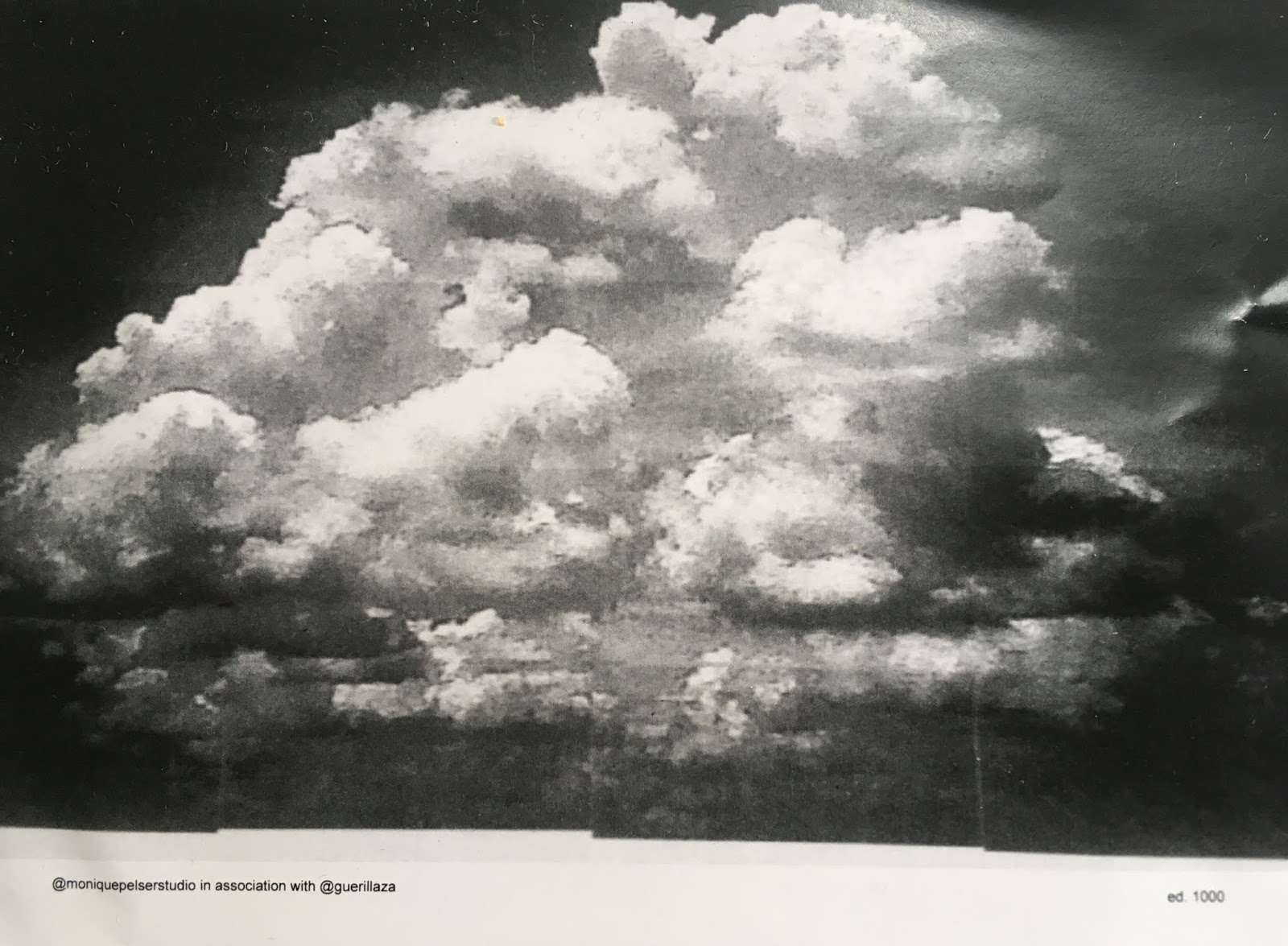
One of the artwork fliers, by Pelser, editioned to 1000 - part of 'Cloud Series'

Cloud Series is an ongoing performative body of work and research by Pelser that engages issues of movement, flux and migration through the metaphor of clouds. Last month, in association with guerilla gallery, Pelser instigated the first manifestation of this series – a public art intervention at a bridge, a railway station exit, under a flyover, and alongside a freeway offramp. These sites were specifically chosen as nodal points of transmission – of things, people and information. The artist made quick, performative contributions to the public sphere leaving temporary artworks behind. [See 'Behind the Scenes', below.]

Cloud Series contributes to an urban dialogue around public space, access and erasures. The public artworks have since dissipated and this next iteration, of freely distributed works in a limited edition, now picks up the conversational thread. It offers the artwork to the public in a new way, to carry the work forward and extend it in unforeseen directions. It also plays around with the concept of value by making a limited number available for free, and access subject to chance. 

The other artwork flier, by Pelser, editioned to 1000 - part of 'Cloud Series'.

The artist first became interested in cloud formations when re-working JH Pierneef's Johannesburg Station Panels, responding to his elaborate biblical clouds referencing God's omnipresence. She became interested in the omnipresence of information in the media. Travelling the country in search of these landscapes, she would see the best, most elaborate formations while on the highway. Since it was not possible to pull over, she would take images with her phone. Running these images in a digital programme, allowing the low quality and pixilation to be enhanced, created the end result. She then used an application to cut the image into 20 composites.


For further updates, follow @guerillaza and @moniquepelserstudio 


One of the 'Cloud Series' artworks on a car windscreen.

Monday, November 4, 2019

Cloud Series: Behind the scenes

--4 November, 2019, Cape Town--Cloud Series, a group of composite artworks created by artist Monique Pelser, and positioned last month at transit nodes in site-specific parts of Cape Town as a public art intervention together with guerilla gallery, have led interesting second lives.

The Cloud Series artworks are of cumulus clouds, building up in different formations, that speak to themes of movement, migration and flux. They are effectively temporary installations, comprised of differing numbers of smaller images pasted onto surfaces by the artist. They are designed to be temporary works that offer a fleeting message and provocation. The artworks are ephemeral and erode over time, leaving traces of themselves and perhaps being intervened with by other visual modes and tags, creating in the process a kind of urban dialogue. Indeed, this is what has transpired.

The Cloud Series at the Salt River site was installed across a series of pillars where the work created the illusion of a cloud through which commuters entered and exited from a tunnel, at a railway station. Within days, a large notice advertising a public event for the South African Navy had been stuck over one of these cloud formations.

Another Cloud Series artwork installation site, at a freeway offramp, began to peel away after some days to reveal a graffiti tag that it was obscuring. It became more evident that the artwork is in fact part of a series of formerly erased expressions that add up to a kind of sentence along the curvature of the entire wall, which the City over time has erased with patches of dark grey paint. 

The third intervention, on a bridge, is positioned over an existing artwork that mimics these painted-over grey squares that cover up tags with a series of squares of their own, painted in the urban fabric. Cloud Series was positioned against one of these squares as backdrop, creating an artistic double play.

There are two more sites to go in this series of public art interventions by Pelser, manifested in conjunction with guerilla gallery. (See the IG feed @guerillaza).

Below are three time-lapse videos giving a behind-the-scenes glimpse of how the artist created the composite performative artwork interventions, sheet by sheet, at each site:


Tuesday, October 22, 2019

Cloud Series: #somethingintheair


--22 October, 2019, Cape Town--Artist Monique Pelser, in association with guerilla gallery, instigated the first of a two-part performative public art intervention in Cape Town last weekend at a traffic overpass, a railway station exit, a bridge underpass, and a freeway offramp. The sites were carefully chosen as nodal points of transmission – of people, things and information. The artist made short performative interventions that left behind temporary artworks in a Cloud Series, as gestural contributions to a public conversation. 
“Clouds are the transformation of matter – that are in constant flux,” says Pelser. “The clouds in this work reference the transformation of digital information, movement, networks and migration.” 
A final duo of sites will soon follow to complete the intervention. Fliers of related limited edition artworks (as above) are this week being distributed along commuter pathways as part of a broader dialogue. 
Photographic documentation of the Cloud Series will soon be shared online. Further background context will be published on guerilla gallery's 'Projects' section once the full intervention is complete.

#clouds #somethingintheair #pixellation #lowfi #performativeresearch #publicart #publicspace #cumulous #technology #icloud #mediation #sitespecific #flux #transformation #information #movement #networks #migration #capetown @moniquepelserstudio @guerillaza

Thursday, February 28, 2019

Performative research project in the works for 2019

--February, 2019--guerilla gallery is this year partnering with an artist in Cape Town to realise a performative research project that comprises a public installation, live performance, documentation and public sphere engagement. The details remain under wraps until the project has manifested but will be published here afterwards, as well as on our Facebook and Instagram channels (@guerillaza).  

During 2019, guerilla gallery will also be folded into a new umbrella entity, Lodestar Lab, which will focus in its curatorial and editorial work upon making connections between current affairs and the contemporary artworld. This sustainability measure will provide the guerilla gallery platform with institutional traction; it remains the same entity in every other respect. 
 
In sum, guerilla gallery is an artist-led, non-commercial platform that operates on a low-budget, low-fi ethos. It aims to help facilitate new and experimental artwork. It does not have its own premises; it is nomadic and shapeshifts according to the projects its founder supports, which are usually site-specific, temporary and performative in nature. 

The platform (b. 2012) has generally mustered support for one key project a year. These have included a collaborative exhibition on art, media and the law held in a factory wing (Elgin Rust's Appeal 2012), a durational performance art intervention from underground stormwater tunnels (Pauline Theart & Kim Gurney's Cape Town Under: The Third Voice) and a mural intervention on a street corner interface (Sandile Radebe's Golden City Plan) - see Projects. After a three-year hiatus, while its founder completed a PhD, the platform is back in action. 

The format is flexible and adaptive to project requirements. guerilla gallery does not have the capacity of a mainstream platform but that also comes with advantages: nomadism, flexibility and positive risk-taking. It also provides a combination of curatorial expertise, artworld knowledge, media experience / publicity interface, advisory capacity, site logistics, installation assistance, partial documentation, breathing space and camaraderie in building an artistic undercommons. 

Signage spotted at the foot of a colonial-era statue of a South African military commander, Major-General Sir Henry Timson Lukin, situated in the Company's Gardens in central Cape Town. Photo: Kim Gurney


Tuesday, September 4, 2018

Call for proposals: guerilla revival


A found artwork on the CPUT campus boundary in Cape Town, following the campus enclosure with barbed wire that was erected during recent student protests and kept in place since then. Image: Kim Gurney.
--Cape Town, 3 September 2018--guerilla gallery, an independent offspace, seeks proposals for a site-specific, temporary artwork or intervention that provokes a different spatial rendering in a thoroughfare or place of waiting, at a site located within greater Cape Town.

guerilla gallery (b. 2012) is a gallery without walls. Instead of comprising bricks and mortar, it moves nomadically to find everyday spaces and awkward places and matches them to artists whose practice engages the spatial realm as integral to meaning.

Past projects have included hosting a group exhibition in a factory wing in Johannesburg’s innercity (Elgin Rust’s Appeal) engaging art, media and the law that took the iterative form of a growing legal argument, a performance art collaboration that included an endurance lullaby sung by Pauline Theart from stormwater tunnels that interlace beneath Cape Town’s city centre (Cape Town Under: The Third Voice), and facilitating a mural intervention on a street corner in Johannesburg’s Jeppe (Golden City Plan), linked to Sandile Radebe’s solo exhibition that rescripted the city.

guerilla gallery is an ad-hoc, independent platform that has just emerged from a three-year hiatus to continue plotmaking from a Cape Town studio backyard. It operates whenever resources and circumstances conspire. It has a lowfi ethos that includes slow time, soft touch, situated knowledges and repurposing the everyday. Visit http://guerillaza.blogspot.com to see if it’s a fit for your practice before applying.

Still here? Send an email by 31 October 2018 to nomadicplatform@gmail.com including: (i) a specific and feasible idea that meets the criteria above; (ii) a short narrative biography about yourself or your collective; (iii) a statement about your practice and what you try to achieve with it; and (iv) a ballpark budget for the intervention that includes an artist’s fee.

who: all artists, makers, do-ers, insurgent imagineers
what: something lowkey, smallscale, with a sense of mischief
where: place of thoroughfare and/ waiting, cape town +
when: deadline 31 october 2018 for manifestation at a convenient moment during the first half of 2019
why: because
connect: @guerillaza

Monday, July 11, 2016

Keleketla's CCTV journal download

The inaugural guerilla gallery project, 'Appeal', a group exhibition co-ordinated by Elgin Rust was featured in a journal called CCTV, published by Keleketla, a non-profit platform run from Johannesburg's Drill Hall. An interview between Elgin and Kim Gurney, founder of guerilla gallery, detailed the motivation behind the exhibition in a Q&A format. Keleketla recently made the journal available as a pdf download, in the link below this entry. 

Here is an extract from Keleketla giving more information about the journal: "CCTV is a survey-type publication of current practitioners and practices in SA and elsewhere, and only comes out on occasion of a specific event/ project. Its aesthetic is influenced by the Medu Newsletters (1979-1984), beautiful silkscreen covers with loose A4 sheets of contributions. This issue launched as a ticket (R50) to a group event titled CIRCUS, to held on 14 September 2012 at the then new art space called King Kong in New Doornfontein. CIRCUS included Johannesburg-based artists and collectives: CUSS, Kadromatt, Rangoato Hlasane, joburg.radio, The Nation, Dokta Spizee, Mathoto and Mma Tseleng. This issue profiles the work of participating artists/ dj’s, as well as other contributions by practitioners in Johannesburg and elsewhere. CCTV aims to use each cover as a platform, a canvas for innovative artists working in silkscreen, litho and lino or other multiples."

Download the journal here:
https://keleketla.org/2016/07/06/cctv-publication-2012/

Monday, November 24, 2014

Jeppestown Mural -- Fotos

A corner of Jeppestown now has a 'Golden City Plan' with a difference. Sandile Radebe yesterday transformed a disused wall surface into a city grid mural morphed into block lettering. Depending upon your orientation as a viewer, his silver and gold block alphabet can be multiply read -- as different letters and sometimes integers instead. In their composite playful form, they suggest both a celebration of the golden city of Johannesburg and its bright lights while also critiquing top-down urban planning.

This public space artwork is conceptual cousin to Radebe's inaugural solo exhibition held last month, 'A Walk in the City', and is facilitated by guerilla gallery. Sandile was assisted by Chaduka Phiri in painting 'Golden City Plan'. Below is documentation from the day -- all the images are taken by Clarence Phiri.  


Saturday, November 22, 2014

Golden City Plan: Jeppestown mural


Should our cities be planned in advance or should people occupy first and let planning come later? This question was posed on Wednesday night at a series of talks around urban land justice and rights to the city in Cape Town's City Hall. The next guerilla gallery project, by Sandile Radebe, intersects with this theme: 'Golden City Plan' is a mural intervention in Jeppestown that takes the form of the city plan while simultaneously critiquing its ideology. 

Radebe will take to Johannesburg inner city streets in the coming days with gold and silver markers on a chosen surface to create his artwork that alludes both to the gold mining history of the city and its bright lights. This mural is not just a regular city plan, however. Its blocks also spell out letters of the alphabet or ciphers that can be differently perceived depending on the viewer's orientation. This perceptual play in turn unsettles assumed fixities of the city plan and mapping in general. 

Radebe writes in his artist's statement: "The city plan, in its ambiguous form and sense, changes its meaning, its behaviour and ultimately nature. The conventions of writing, or the point of the alphabet, the purpose of transcribing, and indeed the purpose of reading, all get stretched to a new and unexpected end."

In this mural, everyone constructs their own reading or idea of a city and this reading starts with Radebe's own sense of place, "deciphering the graffiti that embellishes the city, the street etiquette, the lingo, the sounds of foot traffic, the vehicles, the trucks, the taxis, the busses, the police sirens; the smell of food, the smell of urine, the smell of oil visible on the tarmac on the streets". He adds": "It's sunshine piercing through the buildings and its shadows... It's night-time, and all of it encapsulated in a line to facilitate marking my presence as a part of the city."

This mural intervention links in concept and aesthetic to Radebe's inaugural solo exhibition, 'A Walk in the City', held last month at the National School of the Arts gallery in the round. See the project website for more: http://walkinthecity.withtank.com


--KG
'Alphabet Soup II' (2014), marking pen on drawing chart paper: Sandile Radebe

Sunday, October 26, 2014

Next public space intervention: Johannesburg


Sandile Radebe's maquette for public sculpture: 'A Walk in the City', NSoA installation view (2014)
--guerilla gallery, an offspace for experimental work, manifests nomadically when circumstances and resources conspire with a flexi-format according to each project's needs. At its heart is an activation of unusual spaces married to conceptual intent. The platform due to its nature has unpredictable gestation times and aims to enable something a little different with each iteration.

Last year, we ventured underground into Cape Town's network of subterranean tunnels, activating these spaces at three different public interfaces with a one-hour endurance lullaby sung by Pauline Theart (see Projects section: 'Cape Town Under: The Third Voice').

Next month, we are venturing back above ground and to our founding city, Johannesburg, for a public space intervention by graffiti artist and muralist Sandile Radebe. The execution of the artwork itself will be unannounced but documented here as and when.

This public artwork is conceptual cousin to Sandile's inaugural exhibition, 'A Walk in the City', hosted this month at the National School of the Arts (NSoA). It takes his language play on the Johannesburg city grid from the gallery environs back to its inspiration: public space. For more on this, visit the exhibition's project website.

 --KG, Cape Town

Sandile Radebe's graffiti block lettering on the floor of his installation for 'A Walk in the City' @ NsOA (2014)

Friday, November 29, 2013

Cape Town Under: a review

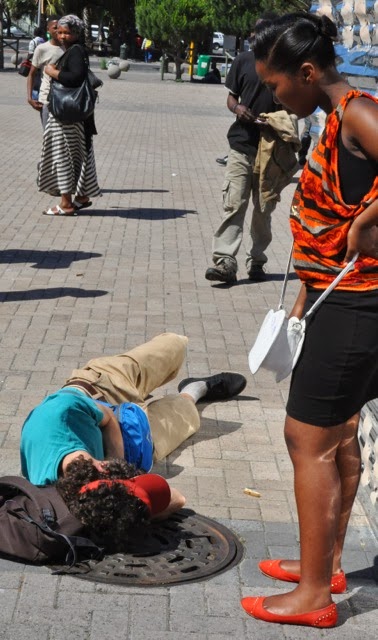
Just over a week after flashfloods hit the Cape, guerilla gallery staged a sound art intervention in the historical stormwater tunnels that run under the city's skin. The weather turned just in time: a strong but manageable water flow formed a sonorous backing track to the lyrical tones of Pauline Theart's voice, which she projected in a live performance from the depths to echo into public space above. Good weather meanwhile let passersby get drawn in for a closer glance at these usually invisible spaces through manhole interfaces above. The tunnels  were built hundreds of years ago first as canals and then enclosed and are now paved over by streets.

This collaborative work, 'Cape Town Under: The Third Voice', was conceived and curated by Kim Gurney as part of a broader project called LAND, organised by the Gordon Institute for Performing and Creative Arts at UCT. It effectively aimed to briefly turn the tunnels into a musical instrument of sorts as a lone voice animated them with an hour-long endurance lullaby sung at access interfaces. The song was stripped of words to evoke a common referent and to help Theart improvise with the tunnel the 'third voice' through echoes and refrains in a kind of co-authorship with the site. She repeated the performance at three different sites over two days.

With special thanks to our tunnel operators who handled underground logistics - Matt Weisse and Gresham Chibwaz - as well as City Roads & Stormwater, The Castle's management and Gipca's support that together helped make this project possible.

Images below by Marguerite Townley-Johnson, except where indicated. For more information, visit the dedicated project website: http://capetownunder.withtank.com

Site 1: The Castle, Strand Street trapdoor interface (22 November)

Photo: M. Townley-Johnson

M. Townley-Johnson

Photo: M. Townley-Johnson

Photo: M. Townley-Johnson

Photo: M. Townley-Johnson


Echo manhole: The Castle Lawns
Photo: M. Townley-Johnson

Photo: M. Townley-Johnson

Site 2: Grand Parade parking lot (22 November) 

The performance site, right with safety cone, prior to intervention. Image: K. Gurney

Photo: M. Townley-Johnson
Image: K. Gurney
Image: K. Gurney

Photo: M. Townley-Johnson

Photo: M. Townley-Johnson

Photo: M. Townley-Johnson

Photo: M. Townley-Johnson

Photo: M. Townley-Johnson
Add caption

Echo manhole, Grand Parade. Photo: M. Townley-Johnson

Echo manhole, Grand Parade. Photo: M. Townley-Johnson
 Site 3: The Castle Lawns (23 November) 

Photo: K. Gurney

Photo: K. Gurney

Photo: K. Gurney

The echo manhole. Photo: K. Gurney
The echo: closeup. Photo: K. Gurney
The walk to the echo. Photo: K. Gurney